Skip to content

Flowers feel like one of those gifts that rarely go wrong. You can send them for Mother’s Day, a birthday, a hospital visit, a housewarming, an apology, or just a small thank-you, and they usually seem to fit the moment. A bouquet is pretty, polite, and thoughtful without feeling too personal or too casual.
That is probably why most of us choose flowers by focusing on the easy things first: whether the bouquet looks nice, whether the colors feel right, whether it will arrive fresh, whether the price makes sense, and what to write on the card.
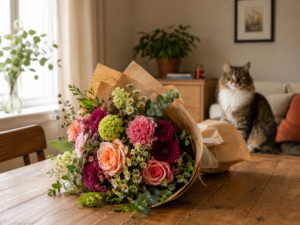
But before sending flowers, there is one small question many people never think to ask: does this person have a cat at home?
If the answer is yes, flowers are no longer just about color, style, or taste. Some bouquets can create a problem the sender never intended, especially if they contain lilies.
To us, lilies look elegant and harmless. They show up in holiday bouquets, sympathy arrangements, white floral designs, and Mother’s Day flowers all the time, so choosing them can feel perfectly normal. For cats, though, certain lilies are not ordinary flowers.
According to the FDA, true lilies and daylilies are dangerous for cats, and the risk is not limited to the petals. The leaves, stems, pollen, and even the water in the vase can all pose a risk. In some cases, even a small exposure may lead to serious issues, including acute kidney injury.
That can feel surprising. After all, a bouquet seems like such an ordinary, harmless gift. But that is exactly why this detail matters. Most people who send lilies are not being careless. They simply do not know this is something they are supposed to check.
Quick answer
If the recipient has a cat, do not send lilies. True lilies and daylilies can be dangerous to cats, and the risk is not limited to eating the petals. Pollen, leaves, stems, and even vase water may be a problem. If you are not sure whether someone has a cat, skip lilies and choose another bouquet.
“Not Eating It” Does Not Always Mean Safe
When people first hear that lilies can be dangerous to cats, their reaction is usually understandable. Cats are meat eaters, so why would they bother with flowers? And if the bouquet is placed somewhere high, it can seem like the problem is already solved.
That line of thinking makes sense, because most of us picture the danger in a very obvious way: a cat sitting beside the vase and chewing through the petals. But exposure does not always happen that clearly.
A cat does not have to eat an entire flower for there to be risk. Pet Poison Helpline notes that lilies in the Lilium and Hemerocallis families are especially dangerous to cats, and the exposure is not always obvious. Pollen can fall onto a table, the floor, or the cat’s fur. Vase water can also be a problem, especially for cats that like drinking from cups, sinks, or random containers around the house.
That is what makes this easy to underestimate. In real life, the risky moment may not look dramatic at all. A cat may brush against the bouquet, get a little pollen on its fur, and walk away before anyone notices. Later, it simply does what cats do: it cleans itself.
If the owner later notices vomiting, loss of appetite, low energy, or unusual behavior, it may no longer be a casual “wait and see” situation.
So if you are the person sending flowers, the safest rule is simple: if the recipient has a cat, do not send a bouquet with lilies.
You do not need to guess whether the cat will touch the flowers, or assume the bouquet will stay safely out of reach. A gift should make someone’s day easier, not become something they have to manage in a hurry or worry about at home.
Asking Before Sending Flowers Is Not Awkward
Some people hesitate to ask because they do not want to ruin the surprise. But in real life, a question like this rarely feels awkward. If anything, it can make you seem more thoughtful.
You do not have to make it a big conversation. A simple message is enough: “Do you have a cat at home? I just want to make sure the flowers are safe.” If you want to keep it more general, you can ask, “Are there any flowers your pets should not be around? I want to choose something pet-friendly.”
For someone who has a cat, that kind of question can feel considerate. It shows that you are not just clicking the prettiest bouquet and moving on. You are thinking about the home where the gift will actually be placed.
If you really do not want to ask, or you want to keep some of the surprise, take the safer route: skip lilies, avoid bouquets with unclear flower lists, and do not order only by looking at the main photo. If you are ordering through a florist, add a clear note saying the recipient has a cat and the bouquet must not include lilies.
If the florist cannot confirm that, choose something else.
Online flower delivery is where this can get especially tricky. A bouquet might be described as “classic white flowers,” “elegant seasonal arrangement,” or “premium mixed bouquet,” but those names do not always tell you exactly what is inside. The photo may look lovely, and you may not recognize every flower in it. Florists may also substitute flowers depending on season and availability, so the bouquet that arrives may not match the photo exactly.
So do not make the note vague. Be direct: “No lilies. The recipient has a cat.” That is much clearer than saying something like “please make it pet-friendly if possible.”

If You Do Not Know Whether They Have a Cat, Skip the Lilies
This is a simple but useful rule: if you are not sure whether someone has a cat, skip the lilies.
Gifts do not have to be perfect. Most of the time, they just need to be kind, easy to receive, and not create a new problem. There are plenty of other flowers, so there is no real reason to choose one that could become a serious risk in the wrong home.
You can choose a simpler bouquet with flowers that are easier to identify and confirm. Roses, gerbera daisies, and orchids are often treated as safer options for homes with cats, but it is still smart to check the exact flowers with the florist.Mixed bouquets can include extra greenery or substitute flowers, so do not rely only on the main flower name. If you are unsure, the ASPCA’s toxic and non-toxic plant database can be a useful place to check.
One thing is worth making clear: “safer” does not mean a cat should be allowed to chew on the bouquet. Even flowers that are not highly toxic can still upset a cat’s stomach if eaten, so flowers should still be kept out of reach in a home with pets.
Lilies are different because the margin for error is much smaller. This is not just about a cat getting a mild stomachache from chewing on a plant. The ASPCA lists Lilium species as toxic to cats and notes that exposure can be associated with kidney failure.
So the decision does not need to be complicated. If they have a cat, or if you are not sure whether they have a cat, skip the lilies. And if the florist cannot confirm whether the bouquet contains lilies, choose another bouquet.
Simple is safer.
If There Are Already Lilies in the House, Do Not Just “Put Them Up High”
If lilies are already in a home with a cat, do not assume that putting the bouquet on a high shelf solves the problem.
Cats can reach more places than people think. They jump onto tables, cabinets, windowsills, shelves, and counters. They may sniff the bouquet, brush against it, or drink from the vase when nobody is looking. And if pollen has already fallen onto the table or floor, the risk may not stay neatly inside the vase.
The safer move is to get the flowers out of the home, or at least out of any area the cat can access. Keep the cat away from the flowers, leaves, pollen, and vase water. Clean any surface where pollen may have fallen. If the cat may have licked, bitten, brushed against the flowers, or drunk from the vase, contact a veterinarian or an animal poison control service right away.

This is the part where it is better not to wait and guess. Do not start by searching for home remedies, and do not assume everything is fine just because the cat looks normal right now. It is also not something you should try to judge on your own by guessing whether the amount was “enough” to be dangerous.
Pet Poison Helpline treats lily exposure in cats as a medical emergency that needs immediate veterinary attention. The sooner the cat receives care, the better the chances may be.
This is not about panic. It is about not losing time.
A Truly Thoughtful Gift Fits the Person’s Real Life
Most people who send the wrong flowers are not careless. In many cases, they are trying to be kind. They choose a bouquet because it looks beautiful, fresh, elegant, or right for the occasion.
The problem is that beautiful does not always mean suitable. A bouquet of lilies in a home without cats may just be a nice decoration, but the same bouquet in a home with cats can become something the recipient has to remove immediately.
This is true of many small life decisions. We often assume that if something is “nice,” it is nice for everyone. But gifts do not exist in isolation. They enter someone’s actual home, routine, space, and responsibilities.
A person may have cats, be sensitive to strong scents, live in a small space, or simply not have the time or energy to care for flowers. Sometimes, a gift that looks lovely from the outside quietly creates more work than joy.
None of this means you have to overthink every gift. It just means the best gifts are not only beautiful or impressive. They are easy for the other person to receive.
Checking whether someone has pets before sending flowers is simply one small way to make your good intention more complete.
The One Rule to Remember
If you are sending flowers for Mother’s Day, a birthday, a hospital visit, a holiday, or just because, pause for one second and ask: does this person have a cat?
If the answer is yes, skip the lilies. If you are not sure, skip them too. And if you already sent flowers and later realize there may be a cat in the home, let the person know as soon as possible so they can check the bouquet. If a cat may have touched, licked, bitten, or ingested any part of the lilies, contact a veterinarian or animal poison control service right away.
A bouquet is supposed to bring happiness, not risk. A good gift is not just beautiful. It also needs to fit the home it is going into.
Frequently Asked Questions
Are lilies toxic to cats?
Yes. True lilies and daylilies are considered dangerous for cats. The risk is not only from the petals. Leaves, stems, pollen, and even vase water may also be a problem. If you are sending flowers to someone who has a cat, it is safest to skip lilies completely.
Is lily pollen dangerous to cats?
Yes, lily pollen can be dangerous for cats. A cat may brush against a bouquet, get pollen on its fur, and later lick it off while grooming. That is why simply keeping lilies in a vase is not always enough if there is a cat in the home.
What should I do if my cat touched lilies?
If your cat may have touched, licked, bitten, or ingested any part of a lily, contact a veterinarian or animal poison control service right away. Do not wait for symptoms to appear, and do not try to judge the risk by yourself based on how much contact you think happened.
Is lily vase water dangerous for cats?
Lily vase water can also be risky because plant material or pollen may get into the water. Some cats like drinking from cups, sinks, or vases, so a bouquet with lilies should not be left anywhere a cat can access the flowers or the water.
Can I send lilies to someone who has a cat?
It is better not to. Even if the flowers look beautiful, lilies can create a serious problem in a home with cats. If the recipient has a cat, or if you are not sure whether they do, choose another bouquet and ask the florist to avoid lilies.
What flowers are safer to send to someone with a cat?
Roses, gerbera daisies, and orchids are often treated as safer options for homes with cats, but you should still confirm the exact flowers with the florist. Mixed bouquets may include extra greenery or substitute flowers, so ask clearly and avoid any bouquet that cannot be confirmed.
References
FDA. “Lovely Lilies and Curious Cats: A Dangerous Combination.”
ASPCA. “Lily.”
Pet Poison Helpline. “Lilies.”