Skip to content

Some foods never really seem like they could keep you awake. Coffee does. Most people know that an afternoon latte, strong tea, or even milk tea can come back to bother them at bedtime. Chocolate, though, usually sits in a different category. It feels more like a small reward than a stimulant.
Maybe it is a square of dark chocolate after dinner. Maybe it is a few chocolate chips while watching a show, or a warm cup of hot cocoa on a cold evening. None of that sounds like a sleep problem. If anything, chocolate feels like the kind of thing you reach for when you are trying to wind down.
So it often goes unnoticed.
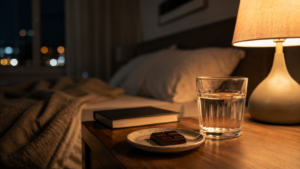
Maybe you have had a night like this: no coffee, no tea, nothing that seemed especially stimulating — just a little chocolate after dinner. Then you get into bed and realize your body feels more awake than it should.
There may be a real reason for that.
For some people, chocolate can make sleep a little harder than expected, especially if they are sensitive to caffeine or other mild stimulants. It does not mean chocolate is bad, and it does not mean everyone needs to stop eating it at night. But if your sleep has been feeling a little off, nighttime chocolate is one small habit worth paying attention to.
Quick Answer
Chocolate can keep some people awake at night, especially if it is dark chocolate or a cocoa-heavy drink like hot chocolate. It contains caffeine and theobromine, which may matter if you are sensitive to stimulants.
If your sleep feels worse after nighttime chocolate, try removing it from your evening for 5 to 7 days. If your sleep improves, move chocolate earlier in the day instead of giving it up completely.
Chocolate Is Not Just Sugar
When people hear that chocolate might affect sleep, the first thing they often think about is sugar. That makes sense. Very sweet foods at night can make some people feel uncomfortable, a little heavy, or just not fully settled, and for some, sleep may feel less steady afterward.
But chocolate is not exactly the same as regular candy. It comes from cocoa, and cocoa naturally contains compounds that may make some people feel more alert. Caffeine is one of them, but there is also theobromine, a cocoa compound most people do not really think about when they reach for chocolate.
That slightly bitter, rich, almost “energizing” feeling you get from dark chocolate is not completely imaginary. It does not mean chocolate works like coffee, but it does mean there is more going on than sweetness.
A piece of chocolate usually will not hit you like a strong cup of coffee. Still, the body does not always react in neat, predictable ways. If you are sensitive to stimulants, even a small amount can sometimes be enough to notice.
Timing matters too. During the day, you may not feel much because you are already working, walking, talking, and moving through your normal routine. At night, when your body is trying to slow down, that same small stimulating effect can become easier to feel.
Dark Chocolate Is Easy to Misjudge
This is not about blaming dark chocolate. Many people like it because it is less sweet, tastes richer, and does not always make them want to keep eating the way regular candy can. Some people even reach for a small piece of 70%, 85%, or 90% dark chocolate in the afternoon when they are tired, because it feels cleaner or more satisfying than cookies.
The issue is that dark chocolate contains more cocoa, and the higher the cocoa content, the more noticeable those cocoa-related compounds may be. In other words, the more “pure,” “bitter,” and “rich” the chocolate tastes, the less you should automatically treat it like a harmless bedtime snack.
This is where the mix-up often happens. After dinner, you want something small, so you grab a piece of dark chocolate and think, “This is not very sweet, so it is probably better than cookies.” Then later, when you lie down, sleep just does not come.
And that is the part worth noticing: dark chocolate may have less sugar than cookies, but that does not mean it is better to eat before bed. Those are two different things.
Not every piece of chocolate will affect you the same way. But if you are eating high-cocoa dark chocolate at night, and you already know coffee, tea, or milk tea can mess with your sleep, dark chocolate should probably be on your list of things to test too.
Hot Chocolate Is Not Always a Bedtime Drink
Hot chocolate is easy to misunderstand because it looks so much like a bedtime comfort drink. It is warm, sweet, and nice to hold in your hands. Especially in winter, a cup of hot cocoa feels like it belongs naturally with a blanket, pajamas, and a soft bedside lamp.
But hot chocolate is not the same as warm milk. If it contains enough cocoa powder, or if you are the kind of person who sleeps poorly after even a little caffeine, it may not be as gentle as it seems.
Some people drink hot chocolate and feel relaxed. That is completely fine. Others may feel a little more awake afterward — not like they just had coffee, but enough to notice when they get into bed and do not feel as sleepy as expected.
That kind of effect is easy to miss. You may blame stress, your phone, a late dinner, or simply not moving much during the day. Those things might matter too. But if your sleep often feels worse after drinking hot chocolate at night, it is worth testing the drink instead of guessing.
You do not have to give it up completely. Just move it earlier for a few days. Have it in the afternoon instead, or skip it close to bedtime and see whether your sleep feels different.
How to Tell If Chocolate Is Affecting Your Sleep
The easiest way to tell is not to decide whether chocolate affects everyone, because it clearly does not affect everyone the same way. Some people can drink coffee at night and sleep like nothing happened. Others have milk tea at 3 p.m. and still feel too awake after midnight.

So the more useful question is not, “Does chocolate affect sleep?” It is, “Does chocolate affect my sleep?”
To find out, take chocolate-related foods out of your evenings for 5 to 7 days. You are not quitting chocolate, and you are not trying to be perfect. You are just removing it from the nighttime routine long enough to see whether your sleep changes.
This does not only mean chocolate bars. Hot cocoa, mocha, cocoa-based drinks, chocolate protein powder, chocolate-flavored energy bars, chocolate ice cream, and chocolate cookies all count too. Many people say they did not eat chocolate at night, when what they really mean is that they did not eat “a piece of chocolate.” Cocoa can show up in more places than you think.
You do not have to avoid chocolate all day during this test. A piece earlier in the day is still fine for most people. The key is to keep it out of the evening, especially during the last 4 to 6 hours before bed.
Then pay attention to what actually changes. Do you feel sleepy more easily? Is your mind less busy when you lie down? Do you wake up less during the night, or feel more rested in the morning? Even a small improvement can tell you something.
If nothing changes, chocolate is probably not your main issue. Your sleep may be affected by something else, like stress, an uneven schedule, too much phone time at night, a late dinner, a warm room, or not moving much during the day.
But if the difference is obvious, the answer is pretty simple. You do not have to give up chocolate. You may just need to move it earlier in the day.
Who Should Be More Careful With Chocolate at Night
Nighttime chocolate is not a problem for everyone. But if any of these sound familiar, it is worth paying a little more attention to your own reaction.
If you already know coffee affects your sleep, chocolate is worth watching too. Maybe you can drink coffee in the morning, but not in the afternoon. Maybe strong tea, milk tea, or cola clearly makes it harder for you to sleep. If your body reacts strongly to those drinks, chocolate may affect you more than you expect.
You may also want to be more careful when your sleep is already unstable. When you are stressed, overtired, or sleeping lightly, small things can feel bigger. Chocolate may not be the main reason you are sleeping badly, but it can still make it harder for your body to fully settle down.
High-cocoa dark chocolate deserves extra attention, especially after dinner. A lot of people feel fine eating it at night because it seems “healthier” or less sweet than regular candy. But less sweet and better before bed are not the same thing.
Chocolate drinks and chocolate-flavored products can be easy to overlook too. A mocha, a chocolate protein shake, or a cup of hot cocoa may not feel like a caffeine source in the way black coffee does. That is exactly why they can slip past you.
And if you often think, “I did not have any caffeine today,” but still cannot sleep well, it may be worth looking back at the smaller things: chocolate, cocoa powder, chocolate-flavored snacks, or anything with enough cocoa to be worth noticing.
Sometimes the problem is not that you cannot find the cause; it is that the cause does not look like a cause.
What If You Still Want Something Sweet at Night?
This is where the advice needs to stay realistic. A lot of advice tells you not to eat this, not to drink that, and not to do anything enjoyable after dinner. But after a long day, many people do want something small at night. A little sweetness is not always just food. Sometimes it feels like a way to close the day.
You do not need to turn this into a strict rule. If you find that chocolate does affect your sleep, try changing the timing first. Eat it in the morning or afternoon instead, especially if it is dark chocolate. A small piece in the afternoon makes much more sense than one right before bed. You still get the taste you like, but it is less likely to interfere with sleep.
If you simply want something sweet at night, try something without cocoa. It does not have to be perfectly healthy. The point is to remove cocoa and caffeine from the evening first. Maybe that means a little yogurt, a few pieces of fruit, a small handful of nuts, or one plain cookie. Go with what fits your habits. This does not need to become a diet plan.
If what you really want is a warm drink, try warm milk, caffeine-free herbal tea, or even just a cup of warm water. The goal is not perfection. The goal is to avoid adding one more thing that may keep your body alert when your sleep is already not feeling steady.
If You Have Pets, Keep Chocolate Out of Reach
One more thing is worth saying clearly, especially if you have a dog at home.
For people, chocolate is usually a question of, “Will this affect my sleep?” But for dogs, chocolate is not just another snack. It contains theobromine and caffeine, and dogs break those compounds down much more slowly than humans do. That is why darker, more cocoa-heavy products like dark chocolate, baking chocolate, and cocoa powder are especially worth keeping out of reach.

In everyday life, that mostly means keeping chocolate out of easy reach. Coffee tables, bedside tables, the edge of the sofa, and open bags are not great places for it. This matters even more when you are watching TV, having people over, opening snacks, or dealing with holiday treats, because it is very easy to put chocolate down for a moment and forget about it.
To you, it may just be a small piece of something sweet. To a pet, it may be much more serious.
If your pet does eat chocolate, do not try to calculate everything online and wait it out. Contact a veterinarian or emergency animal clinic as soon as possible. Tell them what kind of chocolate it was, roughly how much was eaten, and your pet’s weight.
This is not about panic. It is just a reminder that chocolate is not the same kind of risk for pets as it is for people.
Do Not Turn Chocolate Into the Enemy
At this point, it may sound like chocolate is something you should stop eating. That is not the point.
You can still enjoy chocolate. A small piece you genuinely like can be one of those tiny, real pleasures in a normal day. The point is not to feel guilty about it, but to notice whether the timing works for you.
What matters is timing and personal response. One person may eat chocolate at night and sleep perfectly well. Another may eat a small piece and sleep more lightly. A cup of hot chocolate may relax one person and make another feel a little more awake. None of that is contradictory. Bodies are different.
So the most useful question is not, “Can people eat chocolate at night?” The better question is, “Does my sleep get worse after I eat chocolate at night?”
If not, there is no need to overthink it. If it does, move chocolate earlier in the day. That may be enough.
A Simple Takeaway
If you have been sleeping poorly lately, look at your evening habits first. If chocolate, hot cocoa, or chocolate protein drinks are part of your nighttime routine, try removing them for a few days. Not forever, just at night.
If nothing changes, chocolate may not be your issue. But if you fall asleep more easily, wake up less often, or feel less tired in the morning, then it is probably worth changing the timing.
Sleep problems do not always need a complicated explanation. Sometimes a small habit is simply happening at the wrong time.
You can still enjoy chocolate. Just do not let it quietly wake you up when your body is trying to slow down.
Frequently Asked Questions
Does chocolate have caffeine?
Yes, chocolate can contain caffeine, especially darker chocolate with more cocoa. The amount is usually much lower than coffee, but it may still matter if you are sensitive to caffeine or eating chocolate close to bedtime.
Can hot chocolate keep you awake?
Hot chocolate can keep some people awake, especially if it contains a lot of cocoa powder or if they are sensitive to caffeine and other cocoa compounds. It does not affect everyone the same way, so the easiest test is to avoid it close to bedtime for a few nights and see whether your sleep changes.
Is dark chocolate worse than milk chocolate before bed?
Dark chocolate usually contains more cocoa than milk chocolate, so it may be more noticeable for people who are sensitive to stimulants. That does not mean dark chocolate is bad, but it may be better to eat it earlier in the day instead of right before bed.
How long before bed should you stop eating chocolate?
A simple starting point is to avoid chocolate during the last 4 to 6 hours before bed, especially if you already know caffeine affects your sleep. You do not have to follow this forever, but it is a useful way to test whether nighttime chocolate is part of the problem.
Does white chocolate affect sleep?
White chocolate usually has little or no cocoa solids compared with dark chocolate, so it is less likely to have the same stimulant effect. However, it can still be sweet and heavy for some people at night, so if your sleep feels off, it is still worth paying attention to how your body responds.
Is chocolate dangerous for dogs?
Yes, chocolate can be dangerous for dogs because it contains theobromine and caffeine, which dogs break down much more slowly than people do. Dark chocolate, baking chocolate, and cocoa powder are especially concerning, so keep them out of reach and contact a veterinarian if your dog eats chocolate.
References
USDA National Agricultural Library. “Caffeine Content of Selected Foods and Drinks.”
A reference table for caffeine levels in common foods and drinks, including chocolate.
Judelson DA et al. “Effects of Theobromine and Caffeine on Mood and Vigilance.” PubMed.
A study discussing the effects of theobromine and caffeine on mood and alertness.
U.S. Food & Drug Administration. “Leave Chocolate Out of Rover’s Celebrations.”
FDA guidance on why chocolate can be dangerous for dogs, especially darker and more cocoa-heavy products.